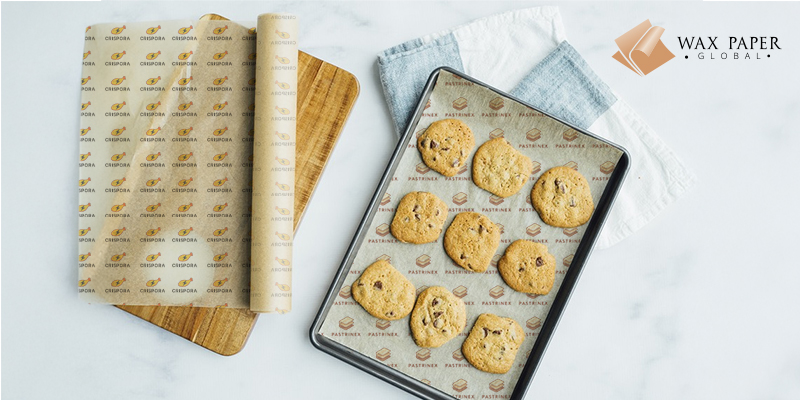
Imagine you are cooking in a kitchen and halfway through the recipe you need a piece of paper and you find two rolls staring back at you - wax paper and parchment paper . They look oddly similar and both claim to make the cooking easier and counters clean.
But in reality one of them has the ability to give perfect cookies while the other a smoke alarm ring. No matter how much they seem similar they are not interchangeable. Wax Paper Global makes it easy for you to understand their basic chemistry to master everything related to cooking without disasters.
What sets both these papers apart is the coating. This one element not only impacts the functionality of these two papers but also the appearance as well. Parchment is lined with silicone, providing a non-stick and grease-resistant surface. On the other hand a wax paper is coated with a thin layer of paraffin or soybean wax giving moisture-resistant properties to the paper.
This silicone-coated paper has the ability to withstand heat for 215-230°C (420-450°F), while the custom wax paper for food is not heat tolerant and can barely withstand heat without the melting of the wax. This one simple and straightforward difference signifies that parchment paper is best for baking while wax paper is for food wrapping.
In every aspect a waxed paper carries no similarity with a printed parchment paper for food. These are two kitchen tools with starkly different personalities. A cold use wrapping paper is coated with a layer of soybean wax or paraffin that makes it resistant to moisture but certainly not heat-resistant. Conversely, the presence of wax is the reason that this paper can’t be used near heat.
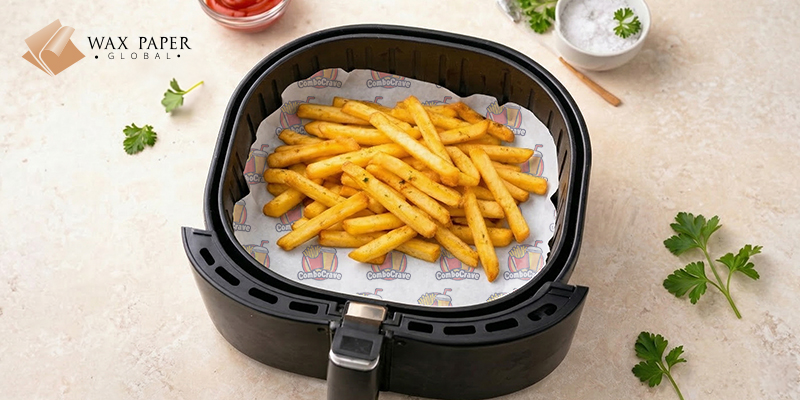
It is mostly preferred for cold uses like storing leftovers, wrapping sandwiches or mildly hot food, and layering cookies. If the temperature gets high the wax would melt meaning that it is not intended for heat-based food prep. Parchment paper on the other side is completely heat-safe and used for cooking, roasting, and baking meaning that it aligns with both oven and air fryer cooking.
| Property | Wax Paper | Parchment Paper |
|---|---|---|
| Heat Resistant | ❌No | ✅Yes |
| Surface | Moisture resistant with smooth surface | Grease and oil resistance, semi-translucent, non-stick surface |
| Coating | Soybean wax or paraffin | Silicon coating |
| Oven Safety | ❌No | ✅Yes |
| Common Uses | Dough rolling, layering cookies, cold-food wrapping | Non-stick cooking, lining baking trays, or roasting |
| Best For | Storage, wrapping, cold food preparation | Air fryer, baking, roasting |
| Non-Stick Ability | Moderate | High |
| Ideal Kitchen Role | Storage tasks | High heat-based cooking |
Both food wrapping papers can easily be identified with their texture, coating, and intended use.
Parchment paper has a matte and slightly textured surface, while the wax paper has a smooth surface.
Wax paper has a distinctive semi-transparent appearance and the parchment has a more opaque look.
A personalized wax paper is solely for wrapping cold or mildly hot food. It's best for storage purposes. While showcasing the a href="https://waxpaperglobal.com/blogs/how-parchment-paper-helps-bakers-bake-smarter" class="text-blue-500 hover:underline">baking properties< parchment paper is used for high-heat and oven related cooking.
Having similarities doesn’t mean the common perception is that both custom food papers share similarities but if you look closely they differ in every perspective. A waxed paraffin paper is limited to wrapping and storing food in cold conditions. Whilst silicone-coated parchment excels in roasting, baking, and air fryer cooking. Differentiating between them comes down to an individual’s understanding of various branded wrapping solutions.
Butcher Paper vs. Parchment...
Discover how butcher paper and parchment paper differ in material, coating, and cooking uses. Find out which paper works...
Is Wax Paper Edible or Harmf...
Learn if wax paper is safe to eat, its coating materials, and health risks. Understand proper usage and why it should no...
Dry Wax Paper vs. Wet Wax Pa...
Discover how dry and wet wax paper differ in texture, coating, and performance. Find out which option works best for wra...
Can You Use Parchment Paper...
Learn whether parchment paper is safe in an air fryer. Discover best practices, cooking temperatures, and common mistake...